Modular and scalable – now in higher power
From grid connected BESS supporting FCAS, arbitrage and balancing support – to off-grid BESS and SAPS, where Pixii delivers smarter microgrid control, remote diagnostics, and future-proof flexibility.
Smarter control with Pixii EMS
The Pixii PowerNode goes beyond energy storage, providing fully autonomous management & control coordination between power sources and loads – ensuring efficient energy distribution, load management, battery optimisation, and data logging with granular detail. All under one cyber secure digital platform fully developed by Pixii engineers in Europe and Australia.
Trusted safety and compliance
Certified to the toughest international standards (UL, IEC, NFPA, AS/NZS & UL9540A). All our systems are tested and validated for safe operation and durability. With more than 2 800 sites installed worldwide, Pixii combines a proven track record and direct support from the Pixii team.

Gain full control with reliable off-grid capability and true independence from grid constraints

Modular, factory-tested design
reduces on-site work and installation costs by over 60%
Scalable and redundant
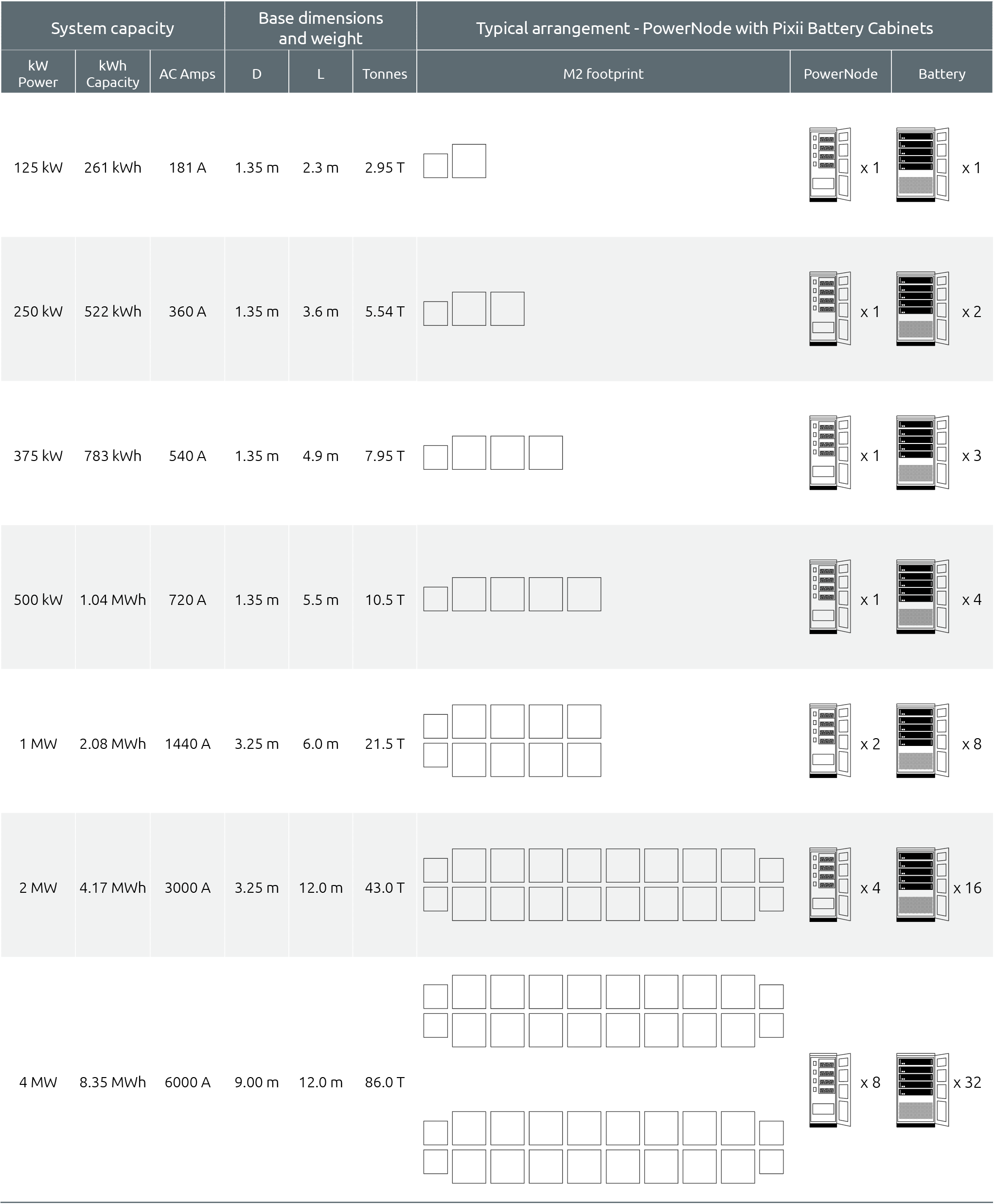
From 100kW to 10MW – Pixii PowerNode scales seamlessly for use in C&I projects to multi-megawatt utilities. Plug-and-play parallel expansion provides installation flexibility, increases uptime and simplifies maintenance.
Maximum efficiency, lower lifetime cost
With conversion efficiencies up to 98.5% and optimized thermal design, the PowerNode cuts losses and operating expenses. Every kilowatt-hour delivers maximum ROI.
Built for every application
Functionality everywhere – metropolitan network connected community batteries, regional network and SWER line support, microgrid backup, and weak grid, HVDC EV charging. Configurable to suit every application, the Pixii PowerNode with flexible EMS control is your total solution.
- DC microgrid
- Black start islanding
- Spinning reserve
- Droop control
- Overload/power: 150% for 180ms 120% for 60 seconds
- 1 Sec. Frequency Services (FCAS)
- Seamless transfer
- Peak shaving
- Demand charge reduction
- Energy shifting
- EV charging
- Diesel gensets integration
- DC & AC coupled solar
- Grid support